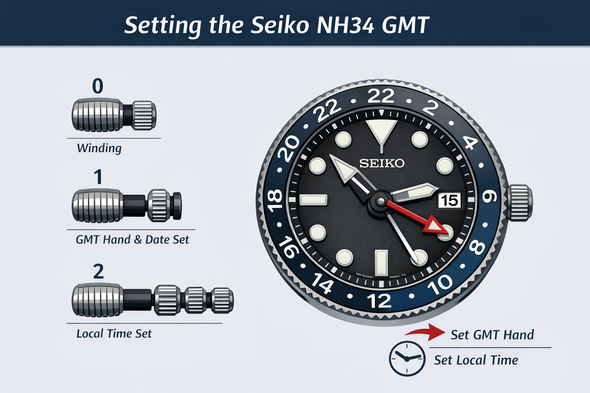
(*) GMT (24-Hour) Display – How to Read It
A GMT watch lets you track two time zones at once (and in some configurations even three). In addition to the regular hour/minute hands (your “local time”), the watch has a GMT hand that completes one full rotation every 24 hours.
Because it runs on a 24-hour cycle, the GMT hand tells you immediately whether it’s daytime or nighttime in the second time zone (e.g., 14:00 vs. 02:00).
1) The Basics: What Each Hand Does
- Minute hand: works normally for all time zones (minutes are the same everywhere).
- Hour hand (local time): shows your current/local time on the regular 12-hour dial.
- GMT hand (second time zone): points to a 24-hour reference and shows the time in your chosen second time zone (“home time” or “reference time”).
2) Reading the GMT Hand with a 24-Hour Scale
Many GMT watches include at least one of these 24-hour references:
- a 24-hour chapter ring / dial printing (numbers 2–24 or 1–24), and/or
- a 24-hour bezel (often rotating).
How to read it:
- Look where the GMT hand points.
- Read the value on the 24-hour scale (dial ring or bezel).
- That number is your second time zone in 24-hour format.
Example
If the GMT hand points to “18”, the second time zone is 18:xx (6:xx PM).
If it points to “03”, it is 03:xx (3:xx AM).
If the GMT hand points to “18”, the second time zone is 18:xx (6:xx PM).
If it points to “03”, it is 03:xx (3:xx AM).
3) Important Note: Not Every Dial or Bezel Has a 24-Hour Scale
Some GMT watches (or certain dial/bezel designs) do not show a printed 24-hour scale. In that case, you can still use the GMT hand reliably — you just convert the reading from the 12-hour markers to a 24-hour reference:
Simple conversion rule (as a quick method):
If there is no 24-hour scale, treat each hour marker as two hours on the 24-hour cycle — meaning the read value is simply doubled.
If there is no 24-hour scale, treat each hour marker as two hours on the 24-hour cycle — meaning the read value is simply doubled.
- If the GMT hand points to 1, read it as 02
- 2 → 04
- 3 → 06
- 4 → 08
- 5 → 10
- 6 → 12
- 7 → 14
- 8 → 16
- 9 → 18
- 10 → 20
- 11 → 22
- 12 → 24 (or 00)
This “doubling” method is a straightforward way to interpret the GMT hand on designs that use a 12-marker layout without a dedicated 24-hour scale.
4) Using a Rotating 24-Hour Bezel (Tracking a 3rd Time Zone)
If your watch has a rotating 24-hour bezel, you can track a third time zone:
- Keep the GMT hand set to your home/reference time.
- Rotate the bezel by the required time difference for the third time zone.
- Read the GMT hand against the bezel to get the third time zone.
Example
- GMT hand is set to UTC (home).
- You rotate the bezel +9 hours to read Tokyo time.
- Now the GMT hand gives Tokyo time on the bezel.
5) Setting the GMT Function (Two Common GMT Types)
GMT watches typically work in one of these ways:
A) “Traveler / Flyer GMT” (independent local hour hand)
- You jump the local hour hand forward/back in one-hour steps when you travel.
- The GMT hand stays on your home time.
B) “Caller GMT” (independent GMT hand)
- Your local hour hand is set normally.
- You adjust the GMT hand in one-hour steps to the second time zone.
Both systems are useful — the difference is simply which hand is independently adjustable.
6) Daylight Saving Time (DST) Reminder
GMT watches are excellent for time zones with fixed offsets (e.g., UTC).
If your second time zone uses daylight saving time, you may need to adjust by +1 hour when DST starts/ends.
If your second time zone uses daylight saving time, you may need to adjust by +1 hour when DST starts/ends.